Tripped Circuit Breaker: 5 Easy and Safe Reset Steps
A tripped circuit breaker can turn a normal evening into a dark, confusing one. One second the lights are on. The next, the kitchen is silent and the microwave is dead. Fortunately, most trips are simple to fix. If you follow a few careful steps, you can restore power in minutes and protect your home at the same time. This guide walks you through the process, explains why the breaker tripped, and shows you the warning signs that mean it’s time to stop and get professional help.
What a Tripped Circuit Breaker Is Really Telling You
A circuit breaker is a safety switch. It watches the electricity moving through a circuit, and when the current gets too high, it cuts the power on purpose. That quick shutoff helps stop wires from overheating, which is how many electrical fires begin. So when a breaker trips, it is not broken. It is doing its job. You can read a short technical overview of how these devices work on Wikipedia’s circuit breaker page. The key idea is simple: the trip is a message. Something on that circuit asked for more power than the wiring should carry, or something went wrong. Your first job is to find out what. If you want to dig deeper, our guide on Remove a Stripped Screw: 8 Easy Methods That Really Work covers this in more detail.
Short Circuit vs Overload: What Caused the Trip?
Before you touch the panel, it helps to understand short circuit vs overload, because the two problems feel different. An overload happens when you plug too many devices into one circuit. Think of a space heater, a hair dryer, and a toaster all running on the same line. The current climbs slowly past the safe limit, and the breaker eventually shuts off. A short circuit is more sudden. A hot wire touches another wire or a grounded surface, and a surge of current flows at once. You may hear a pop, see a spark, or smell something burning. An overload is usually a habit problem you can fix. A short circuit is a wiring or appliance fault, and it deserves more caution.
Circuit Breaker Overload Signs You Should Not Ignore
Your home often warns you before the breaker trips. Learning the common circuit breaker overload signs can save you from repeated blackouts and, more importantly, from hidden heat damage. Watch for these clues:
- Lights that dim when a large appliance turns on
- Outlets, plugs, or cover plates that feel warm to the touch
- A buzzing or crackling sound from an outlet or switch
- A faint burning or hot-plastic smell near a circuit
- Power strips plugged into other power strips
- A breaker that trips every time you run the same appliance
One or two of these signs means you should reduce the load on that circuit. A burning smell or scorch mark is different. Treat it as an emergency, and skip ahead to the section on calling a professional.
5 Steps to Reset a Tripped Circuit Breaker
Resetting a tripped circuit breaker takes only a few minutes, but the order of the steps matters. Rushing can put you at risk or cause the breaker to trip again right away. Work through the five steps below one by one, and stop if anything feels wrong. If you ever see smoke, smell burning plastic, or hear sizzling, leave the panel alone and call for help. Otherwise, a calm and methodical approach is all you need. Keep a flashlight nearby, since you may be working in a dark hallway or basement.
Step 1: Locate Electrical Panel and Prepare
First, you need to find the box. Most homes keep the main panel in a basement, garage, utility room, hallway closet, or on an outside wall. In apartments, it is often inside the unit near the entrance. Once you find it, clear the space in front of it so you can stand comfortably. Make sure the floor is dry and your hands are dry too. Wear shoes with rubber soles if you can. Grab your flashlight so you can read the labels inside the door. If the panel is in a damp place or you see water near it, stop and call a licensed electrician. This connects closely with another common issue — see Unclog a Drain: 7 Easy Steps Without Calling a Plumber for more on that.
Step 2: Turn Off and Unplug What You Can
Next, go back to the room that lost power and reduce the load. Switch off the lights and unplug the devices on that circuit, especially high-power ones like space heaters, microwaves, hair dryers, and vacuum cleaners. This step matters for two reasons. It removes the likely cause of an overload, and it keeps a sudden surge from hitting your electronics when the power returns. If you are not sure which devices are on the dead circuit, unplug everything in the affected area. A little extra effort here makes the next steps much safer.
Step 3: Find the Tripped Breaker
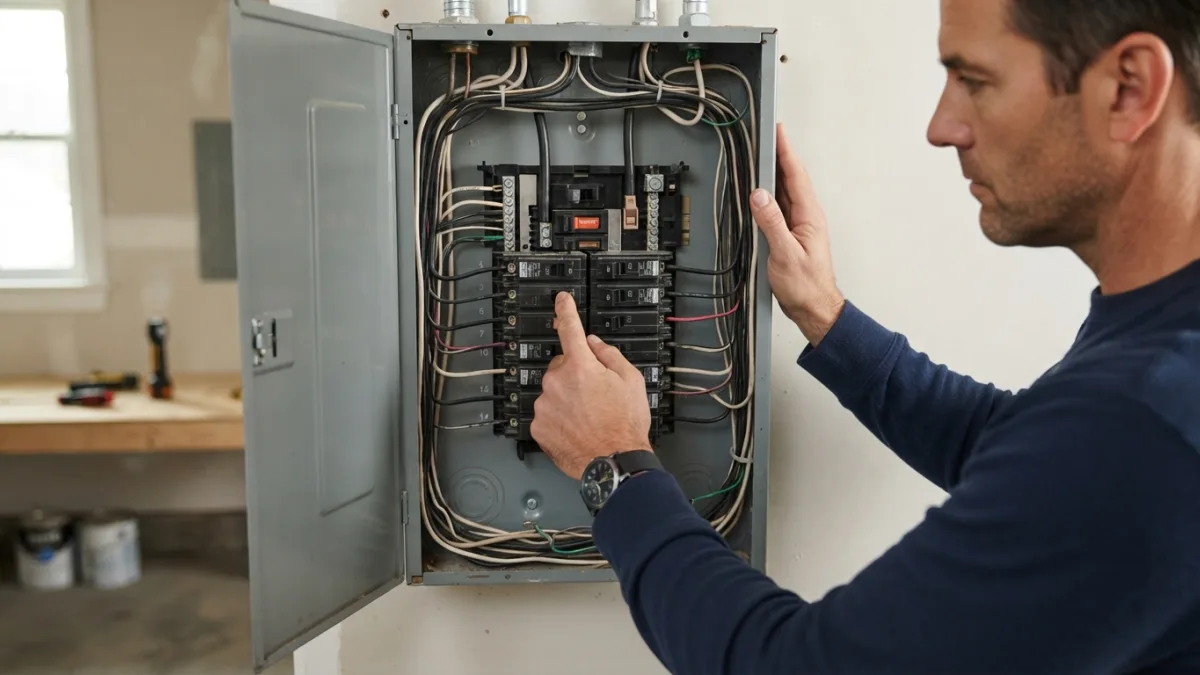
Open the panel door and look at the row of switches. A tripped breaker usually sits in a middle position, between ON and OFF. Sometimes it moves fully to OFF, and some models show an orange or red marker. Check the labels to see which switch matches the dead area. If the labels are missing or confusing, look for the one switch that does not line up with the others. Do not remove the inner metal cover, the one that hides the wiring. You only need the door and the switch handles. Never touch anything except the breaker handle itself.
Step 4: Reset the Breaker the Right Way
Stand to the side of the panel and turn your face away. Use one hand. Push the handle firmly to the full OFF position first. You may feel a small click. Then push it all the way to ON. Skipping the full OFF position is the most common mistake, and it is why many resets seem to fail. If the breaker clicks back to the middle position right away, do not hold it or force it. That means the fault is still there. Switch it to OFF, leave it there, and move to the troubleshooting sections below.
Step 5: Test the Circuit and Watch for Trouble
If the breaker stays on, the work is not quite done. Plug your devices back in one at a time, starting with the least powerful ones. Give the circuit a few minutes between each, and feel the plugs and outlets for unusual warmth. Listen for buzzing. If everything runs normally, you probably had a simple overload, and you can spread your appliances across different outlets in the future. If the breaker trips again when you add one specific device, you have found the culprit. Leave that device unplugged until it is repaired or replaced.
Breaker Panel Safety Tips Every Household Should Know
These breaker panel safety tips take little time to follow and lower your risk during every reset. The Electrical Safety Foundation International offers more home electrical safety resources if you want to learn more. You might also find our article on Adjust Cabinet Hinges: 5 Easy Steps for Even Doors helpful here.
- Keep the area around the panel clear, so you can reach it quickly in an emergency.
- Never stand in water or touch the panel with wet hands.
- Do not tape, tie, or hold a breaker in the ON position.
- Never swap a breaker for a larger one to stop it from tripping. Wires are sized for a specific limit, and a bigger breaker removes that protection.
- Leave the inner cover and the wiring to a licensed professional.
- Label each breaker clearly, so you do not have to guess in the dark.
Children should also stay away from the panel. Treat it like a tool cabinet that only adults use.
How to Reset GFCI Outlet Protection When Power Is Out
Sometimes the panel looks fine, yet an outlet is dead. In that case, the problem may be a ground-fault circuit interrupter, or GFCI. These outlets, which have two small buttons marked TEST and RESET, are common in kitchens, bathrooms, garages, and outdoor areas where water is more likely. To reset a GFCI outlet, unplug whatever is connected, then press the RESET button firmly until it clicks. If power returns, you are done. One GFCI can also protect other outlets down the line, so the dead outlet may be in a different room than the GFCI itself. For background on how these devices protect people from shocks, see this Wikipedia article on residual-current devices, which covers GFCIs. If the button will not stay in, moisture or a wiring fault may be the cause.
Why Breaker Keeps Tripping Even After a Reset
If you are asking why breaker keeps tripping, start with the simplest cause: too much demand on one circuit. Run a quick test. Unplug everything on the circuit, reset the breaker, and add devices back one at a time. If it trips only when one appliance is on, that appliance may be faulty, or it may simply need more power than the circuit can give. A damaged cord, a worn plug, or water getting into an outlet can also cause trips. Older breakers can weaken over time and trip too easily. When a tripped circuit breaker returns again and again with no clear cause, loose or damaged wiring is possible, and that needs a professional.
What to Do When the Breaker Will Not Reset
It is frustrating when the breaker will not reset, but do not push harder. First, confirm you moved the handle fully to OFF before switching it ON. Then unplug every device on that circuit and try once more. If the handle still springs back, or feels loose and floppy, the circuit may have an active short, or the breaker itself may be worn out. In either case, forcing it is risky. Leave it in the OFF position and use other circuits for now. Avoid extension cords that run power from another room as a long-term fix. A breaker that refuses to hold is a sign that something needs expert attention.
When to Call Electrician Help Instead of Trying Again
Knowing when to call electrician help is just as important as knowing how to reset a breaker. Make the call if you notice any of these: For a related walkthrough, check out Find a Wall Stud: 7 Easy Tricks Without a Stud Finder.
- A burning smell, smoke, or scorch marks on an outlet, cord, or panel
- Sparks, loud popping, or a breaker that feels hot
- Water inside or near the panel
- A breaker that trips again and again with no clear cause
- A breaker that will not stay on at all
- Any situation where you feel unsure or unsafe
If you see smoke or flames, leave the building and call emergency services first. For general product and fire safety guidance, the U.S. Consumer Product Safety Commission is a trusted resource. A licensed electrician costs money, but a fire costs far more.
FAQ: Resetting a Tripped Circuit Breaker
Is it safe to reset a tripped circuit breaker yourself?
Yes, in most cases. Keep your hands and the floor dry, stand to the side, and touch only the breaker handle. If you smell burning or see sparks, do not reset it. Call a licensed electrician.
How do I know which breaker tripped?
Look for a switch sitting in the middle position or one that is out of line with the others. Some breakers also show a colored marker. Panel labels can help you match the switch to the room.
Why must I switch the breaker fully OFF before turning it ON?
A tripped breaker has often not fully reset its internal mechanism. Pushing it fully to OFF first resets that mechanism, so the ON position can hold properly.
How many times can I reset a breaker?
If it trips again right away, stop. Repeated resets can hide a real fault. Find the cause by unplugging devices, and if you cannot find it, call a professional.
Can a tripped circuit breaker damage my electronics?
The breaker is there to protect your home, but sudden power loss and return can stress sensitive devices. Unplug electronics before you reset the breaker, then plug them back in once power is stable.

Ghani Mejber — Founder & Lead Editor
Ghani Mejber is the founder of DIY Homes Hub. After years of living in compact rentals with strict lease rules and limited storage, I started sharing practical, damage-free home upgrades and basic repair guides built for real budgets. Every project I publish focuses on simple tools, accessible materials, and reversible solutions that protect your security deposit.